
AISH TO ADAP — THE COLLISION BETWEEN CERTIFIED REALITY AND POLICY FICTION
THE PETITION IS THE TRIGGER, AND ITS AUTHOR SETS THE LINE

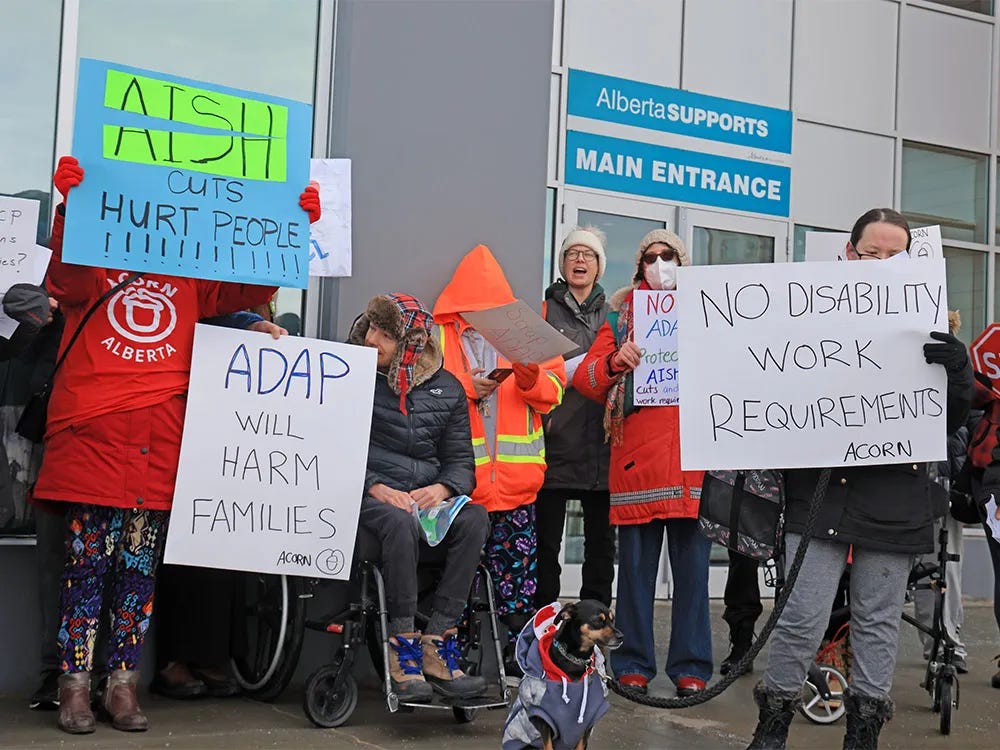
On March 31, 2026, Darryl W. W. Learie, operating through The AISH Page as a recognized community voice and organizing force, announced that the Stop ADAP, Save AISH paper petition—carrying 5,674 signatures—had been delivered to the Alberta Legislature and officially entered into the legislative process. That announcement is not a routine update. It marks the exact moment a grassroots, disability-led mobilization crossed from community pressure into institutional record.
Learie’s role matters because this was not a top-down campaign backed by political machinery. It was built through direct engagement with people living inside the system being redesigned. Every signature represents physical effort, coordination, and trust within a population that faces structural barriers to participation. By moving that effort into the Legislature, Learie converted lived experience into a formal democratic artifact. From that point forward, the issue is no longer dismissible as scattered concern. It is documented, anchored, and tied to a named citizen-led initiative that forced itself into the system.
THIS IS NOT TABLING — THIS IS ENTRY INTO THE SYSTEM
Learie’s own statement is precise and important. The petition has been delivered and entered into the legislative process, but it has not yet been tabled in the Legislature. That distinction matters because tabling is the moment when the petition is formally presented to Members of the Legislative Assembly and enters the visible chamber record.
What has happened is the threshold crossing. The petition now exists within the procedural stream and is awaiting its scheduled presentation. That creates a staging window. The campaign has moved from collection to positioning. The next moment—the tabling—will be the public ignition point inside the Legislature itself, and everything leading up to that moment will determine how much pressure is waiting when it lands.
THE FIRST PRINCIPLE — EVERY AISH RECIPIENT HAS ALREADY QUALIFIED UNDER STEEL CONDITIONS
The strongest ground in this entire issue begins with a fact that cannot be reframed. Every individual currently receiving AISH has already passed a high-threshold, medically verified, function-based eligibility system. This is not a discretionary classification. It is a formal determination by the state that a person’s condition significantly limits their ability to earn a living on a sustained basis.
That is the foundation. These are not hypothetical cases. These are people already assessed and approved under rigid criteria. When the system is redesigned to emphasize labour participation as a central organizing principle, it does not simply evolve policy. It collides with its own prior certification. A system cannot declare that individuals are structurally constrained in their ability to work and then reorganize their survival around an expectation that they will now do so under conditions that have not materially changed.
That contradiction is the core of the argument, and it is unassailable because it is built on the government’s own framework.
THE GOVERNMENT’S COUNTER-STORY — COHERENT, BUT DEPENDENT ON ASSUMPTION
The government’s position is not weak on its face. It argues that ADAP expands eligibility, preserves health benefits, increases flexibility for earnings, and retains AISH for defined exempt groups. It also relies on the fact that some details will be finalized through ministerial order, allowing it to suggest critics are reacting ahead of full implementation.
This is a coherent narrative. But it rests on a critical assumption that has not been operationalized. It assumes that the labour market can absorb and sustain individuals already determined to be severely limited in their ability to participate in it. There is no enforceable obligation placed on employers to hire these individuals. There is no guaranteed accommodation framework tied to the redesign. There is no structural correction to transportation, scheduling, or workplace accessibility that would convert theoretical opportunity into practical reality.
What exists instead is a one-directional expectation. The individual must adapt upward. The system is not required to adapt downward.
THE LABOUR MARKET — WHERE THE MODEL FAILS UNDER CONTACT
This is where the policy loses traction against lived reality. A system that increases work incentives without ensuring work availability is not expanding opportunity. It is redistributing risk. For individuals already verified as unable to reliably depend on employment, this shift introduces instability under the language of flexibility.
The labour market is being treated as a solution without being structurally modified to function as one. That gap is not abstract. It is immediate and lived, and it is precisely what the petition captures. The campaign does not need to speculate. It only needs to point to the absence of enforceable labour-side obligations and ask how a work-oriented model functions without them.
THE TRANSITION PERIOD — STABILIZATION NOW, EXPOSURE LATER
The temporary maintenance of AISH-level payments is presented as protection, but structurally it functions as a delay. It stabilizes recipients in the present while leaving the future condition unchanged. The transition benefit does not eliminate the shift to a lower base structure. It postpones its full impact.
The critical issue is not what happens during the transition period. It is what happens after it ends. If the underlying framework remains tied to labour participation assumptions without enforcement, then the transition is not a safeguard. It is a glide path into reduced certainty.
THE RE-APPLICATION MECHANISM — FRICTION AS FILTER
The re-application requirement is one of the most consequential elements of the redesign, and it must be understood in structural terms. Re-application introduces friction into a population already operating under constraint. Every additional requirement creates points where individuals can fall out of the system, not because their condition has changed, but because the process itself becomes a barrier.
This is not speculation. It is a predictable outcome of administrative design. When access is conditioned on repeated verification, attrition follows. The system sheds participants quietly through complexity, delay, and exhaustion. Whether intended or not, the effect is the same. Re-application becomes a mechanism that reduces participation without requiring explicit exclusion.
THE EXEMPTION LIST — A LINE THAT DEFINES WHO IS EXPOSED
The government emphasizes that some groups remain on AISH, and that is factually correct. But this does not preserve the system as a whole. It defines a protected subset while placing the remainder into a category subject to transition and reassessment.
The exemption list functions as a boundary. It clarifies who is insulated and, by extension, who is exposed. The narrower the exemption criteria, the broader the population that must navigate the redesigned system. This is not a universal safeguard. It is a segmentation of the existing community.
THE PETITION’S POWER — FROM ANNOUNCEMENT TO ACCOUNTABILITY
Darryl W. W. Learie’s March 31, 2026 announcement marks the moment this issue became anchored inside the Legislature. The next step—tabling—will bring it directly into the chamber and formally before elected representatives. Between those two moments lies the critical pressure window.
The petition’s power is not automatic. It is cumulative. It builds through media exposure, public narrative, and political response. What it guarantees is that the issue can no longer be ignored without record. From this point forward, every decision made in relation to AISH and ADAP will exist alongside a documented expression of opposition from those directly affected.
THE FINAL FAULT LINE — CERTIFIED LIMITATION VERSUS ASSUMED CAPACITY
At the center of this entire issue is a contradiction that cannot be resolved through messaging. The state has already certified that AISH recipients face severe and enduring limitations in their ability to rely on the labour market. The redesign assumes a level of labour participation that has not been structurally enabled or guaranteed.
Between those two positions lies the conflict. One is established fact. The other is policy assumption.
The petition led by Darryl W. W. Learie does not need to exaggerate that gap. It only needs to hold it in place and force the question that defines everything that follows.
If nothing in the labour market has fundamentally changed, why is the system being changed to depend on it?
excellent article. Defines all with exacting clarity. I wish & hope that the folks currently on AISH can continue without Smith f**king it all up.
Everyone currently on AISH needs to stay on AISH, and AISH benefits need to be increased and expanded. No ifs, ands, or buts. The disabled of Alberta need and deserve to be lifted out of poverty, hunger, and debt. It's just that simple.