
ENGINEERING DEMOCRACY’S DESTRUCTION THROUGH DEMOCRACY ITSELF
How Constitutions Become The Machinery Of Their Own Defeat


THE LEGAL MASK
Democracy’s most dangerous adversary no longer arrives as an obvious enemy; it arrives dressed as its most devoted guardian. The language of the United States Constitution and Canada’s Constitution Act, 1982, anchored by the Canadian Charter of Rights and Freedoms, is deployed not as a restraint but as a shield for expansion. Every controversial act is wrapped in legality, every aggressive move is framed as compliance, and every challenge is dismissed as ignorance of the law. The brilliance of the tactic lies in its psychological effect: citizens are conditioned to equate legality with legitimacy, even when the spirit of the law is being inverted. Over time, the constitution ceases to function as a boundary and instead becomes a vocabulary—a set of phrases used to justify outcomes already decided. The mask holds because most people are not constitutional scholars; they hear familiar words—rights, freedom, democracy—and assume continuity, even as the underlying meaning shifts beneath their feet.

PROCEDURE OVER PRINCIPLE
The destruction of democratic equilibrium does not require a single catastrophic act; it requires the disciplined accumulation of small, defensible decisions. Each procedural adjustment—an amendment here, a rule change there, a redefinition of authority elsewhere—appears minor in isolation. Legislatures alter committee powers, executives expand regulatory discretion, courts reinterpret precedent, and administrative bodies quietly adjust enforcement thresholds. None of these moves trigger immediate outrage because each can be justified within existing frameworks. Yet the cumulative effect is profound: principle becomes secondary to process, and process becomes the vehicle for power consolidation. Democracy begins to operate like a machine that still runs but produces different outputs. What was once a system designed to balance competing interests becomes one that channels outcomes in a preferred direction, all while maintaining the appearance of neutrality. The public sees continuity; the insiders recognize transformation.
THE NOTWITHSTANDING SWITCH
Canada’s constitutional architecture contains a uniquely potent lever in Section 33—the notwithstanding clause. It was conceived as a narrow democratic override, a mechanism to allow elected governments to temporarily sidestep judicial interpretations in exceptional circumstances. But in the hands of a government willing to normalize its use, it becomes something far more consequential: a pre-emptive switch that can deactivate core rights protections before they are even tested. The clause does not erase rights from the text; it suspends their enforceability in practice. That distinction is everything. Citizens continue to believe their rights exist, while the government operates in a space where those rights cannot be meaningfully invoked. The danger is not merely legal but cultural. Once the use of the clause becomes routine, the expectation of rights protection erodes. What was meant to be rare becomes regular, and what was meant to be exceptional becomes normalized. The constitution remains intact, but its most vital function—guaranteeing enforceable rights—is quietly compromised.

MANUFACTURING “THE PEOPLE”
No democratic system can be reshaped without first redefining its central actor: the people. Authoritarian engineering begins by narrowing that definition, turning a pluralistic citizenry into a selective constituency. Through rhetoric, media amplification, and political framing, “the people” becomes synonymous with a particular identity—ideological, cultural, or regional. Those outside that definition are recast as obstacles, dissenters, or even threats. This redefinition allows power to be exercised in the name of democracy while excluding significant portions of the population from its benefits. It also creates a moral hierarchy in which actions taken against “others” are justified as necessary for the protection of “us.” Over time, this narrative reshapes public perception, making it easier to accept policies that would otherwise be seen as undemocratic. Democracy’s inclusive promise is replaced by a conditional one, where belonging determines legitimacy.
INSTITUTIONS LEFT STANDING, POWER HOLLOWED
The most effective transformations do not dismantle institutions; they repurpose them. Courts continue to hear cases, but their independence is subtly constrained through appointments and pressure. Legislatures continue to debate, but their outcomes become increasingly predetermined. Oversight bodies remain in place, but their mandates are narrowed or their resources reduced. Media organizations continue to operate, but their credibility is systematically undermined until they struggle to function as effective watchdogs. This approach avoids the shock of outright abolition and instead creates a slow acclimatization to diminished capacity. The public sees familiar structures and assumes stability, while the internal dynamics of those structures shift toward compliance. It is a form of institutional hollowing that preserves the shell while altering the substance, allowing power to consolidate without triggering the alarms associated with overt authoritarianism.

THE REFERENDUM WEAPON
Referendums occupy a sacred space in democratic imagination, representing the direct voice of the people. That is precisely why they can be so effectively weaponized. By controlling the conditions under which a referendum occurs—the framing of the question, the timing, the information environment, and the legal thresholds—political actors can shape outcomes while maintaining the appearance of neutrality. A referendum held in a polarized or misinformed context can produce results that reflect manipulation rather than genuine consent. Yet once the vote is cast, its legitimacy is difficult to challenge. The outcome is presented as the will of the people, even if large segments of the population view it as flawed or illegitimate. This creates a powerful feedback loop: the result is used to justify further actions, which in turn reinforce the narrative of democratic mandate. The referendum becomes less a tool of expression and more a mechanism of validation.
ALBERTA AS A LIVE CASE STUDY
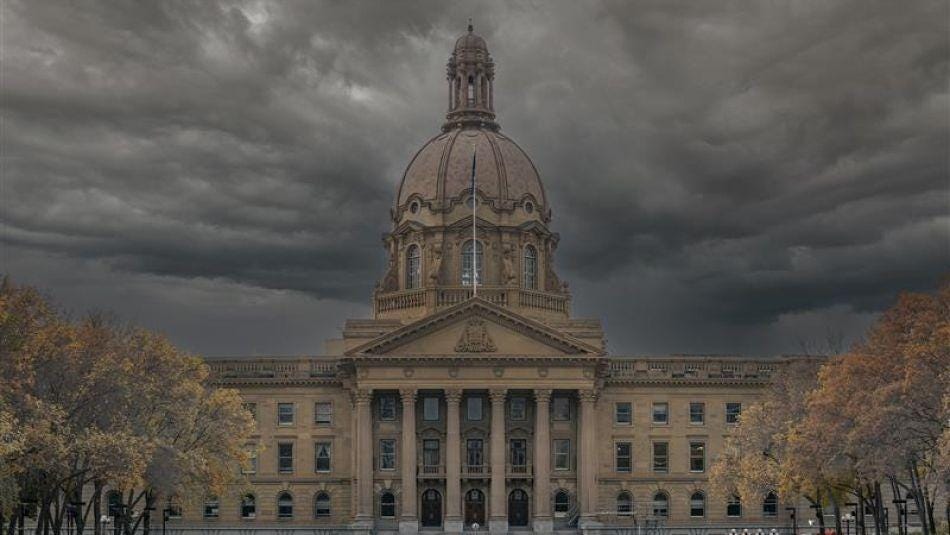
Alberta provides a contemporary example of how these dynamics can converge. Legislative initiatives, referendum frameworks, and political narratives are interacting in ways that test the resilience of democratic norms. Each development—whether related to centralization of authority, electoral processes, or separatist sentiment—can be defended on its own terms. Together, however, they form a pattern that raises deeper questions about direction and intent. The interplay between provincial autonomy, federal relationships, and internal political dynamics creates a complex environment in which democratic instruments can be used to pursue outcomes that may alter the system itself. The situation is not predetermined, but it illustrates how quickly a stable framework can become contested when multiple pressures align.

THE LEGITIMACY TRAP
The effectiveness of this approach lies in its ability to avoid clear violations. Because each step can be justified within existing rules, there is rarely a single moment that demands decisive intervention. Instead, the system enters a state of gradual erosion, where concerns accumulate but remain diffuse. By the time the pattern becomes widely recognized, the institutions responsible for addressing it may already be weakened or compromised. This creates a trap in which legitimacy is continuously asserted but increasingly questioned. Citizens are left navigating a system that appears lawful but feels unstable, unsure of when or how to respond. The absence of a clear breaking point allows the process to continue, often until reversal becomes significantly more difficult.

DEMOCRACY IN FORM, NOT FUNCTION
The endpoint of this trajectory is not the abolition of democracy but its transformation into something that resembles it without fully embodying it. Elections continue, but their fairness may be contested. Rights remain in constitutional text, but their application becomes inconsistent. Institutions persist, but their independence is diminished. The system retains enough of its original structure to be recognizable, yet its operation serves different purposes. This creates a condition in which democratic language and symbols are preserved, even as their underlying meaning changes. For citizens, the challenge becomes distinguishing between form and function—between what democracy looks like and how it actually works.
THE FINAL WARNING
Constitutions are powerful frameworks, but they are not self-enforcing. Their effectiveness depends on the commitment of those who operate within them to uphold both their letter and their spirit. When that commitment weakens, the safeguards they provide can be circumvented through determined and coordinated action. The process does not require abandoning the constitution; it requires mastering it in ways that prioritize power over principle. The ultimate safeguard of democracy is not the document itself, but the collective willingness to defend the values it represents. Without that, even the most carefully designed system can be reshaped into something it was never intended to be.
Thanks for this thought provoking article. Lots to consider. Timely.