
FROM COMMONWEALTH TO COMPLIANCE
THE TRANSFORMATION OF SOCIAL CREDIT FROM MORAL ECONOMY TO COLD WAR ORTHODOXY

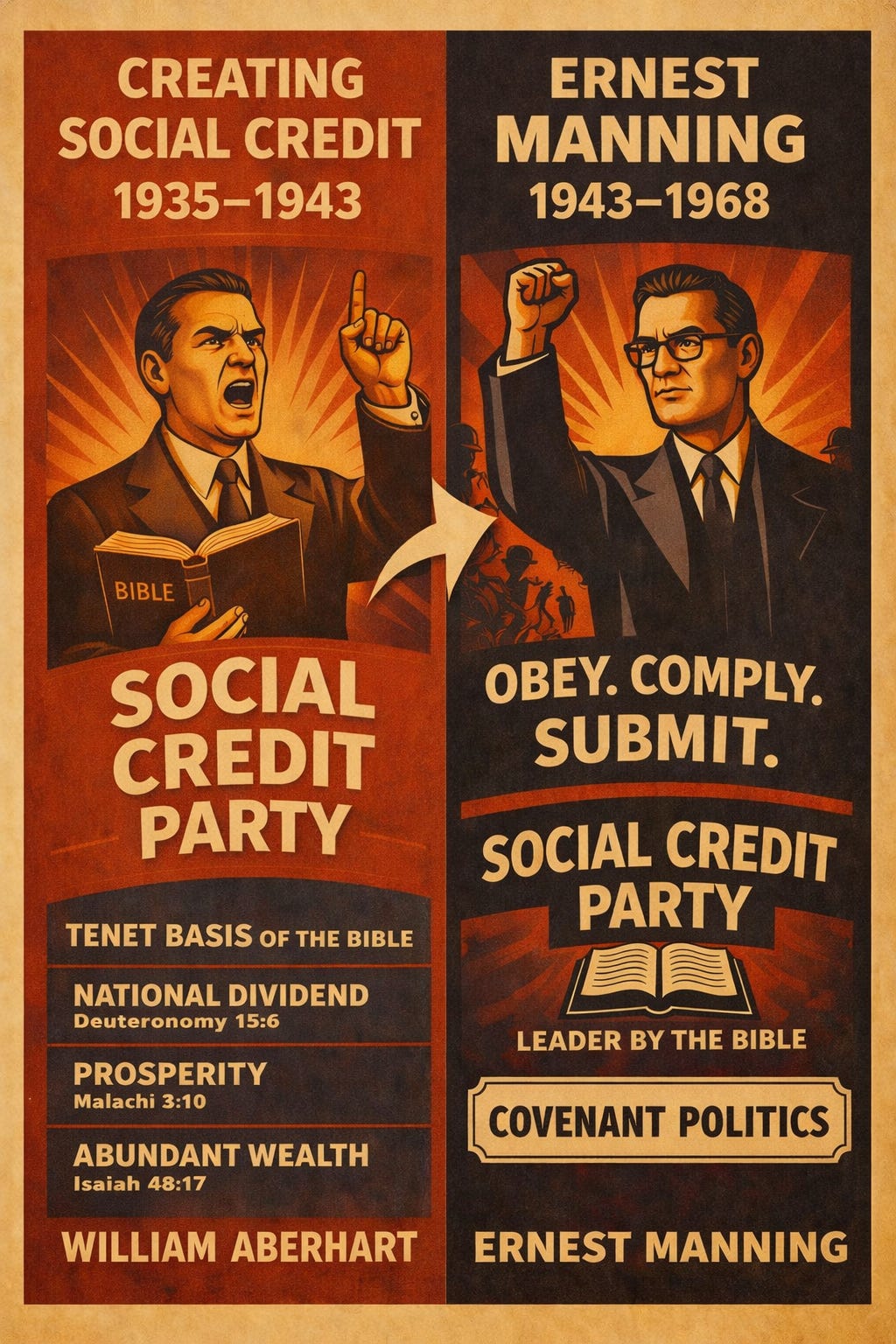
There is a particular kind of political evolution that does not announce itself as rupture, but as refinement. It keeps the same language, the same symbols, even the same moral claims, while quietly reversing their direction. The transformation of Social Credit in Alberta—from its Aberhart-era roots in community-centred, quasi–social gospel economics to the disciplined, anti-socialist posture of Ernest Manning’s long premiership—is one of those evolutions. It is not merely a story of policy drift; it is a story about how a moral framework is reshaped by time, pressure, and fear, until it begins to speak the same words with an entirely different meaning.
THE SOCIAL GOSPEL ROOT: ECONOMICS AS MORAL DUTY
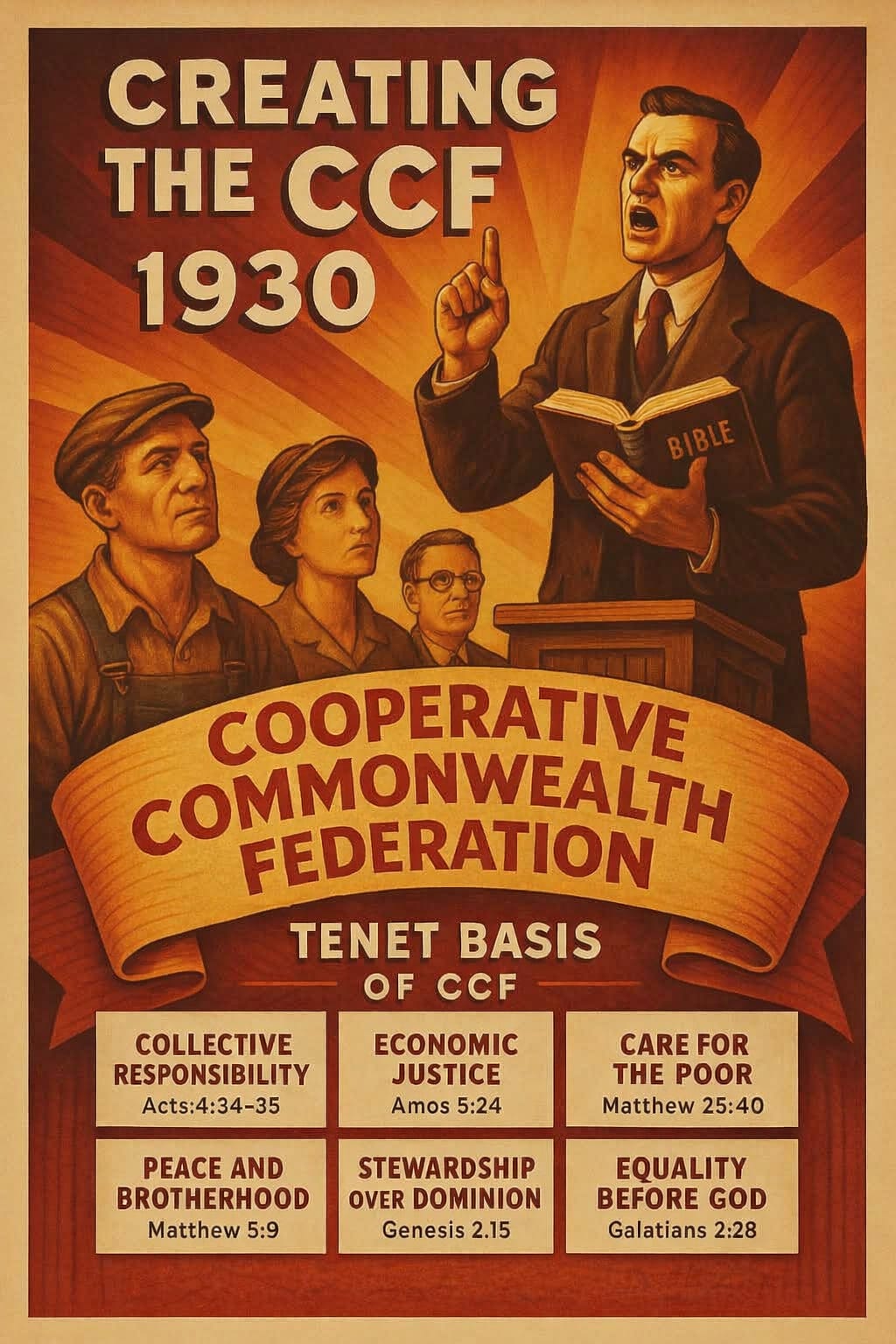
When Social Credit first took hold under William Aberhart in the 1930s, it did not present itself as an ideology in the modern partisan sense. It presented itself as a correction to a moral imbalance. The Great Depression had exposed a system that could produce abundance and yet deliver poverty, wealth and yet widespread insecurity. Aberhart’s framing—drawing heavily from Christian social thought—treated this not as a technical failure, but as a moral one. If society had the capacity to produce wealth, then it had a duty to ensure that wealth reached its people.
The language reflected that orientation. “National Dividend” was not a radical redistributionist slogan so much as a statement of shared ownership in the productive system. “Prosperity” was collective, not individual. “Abundant Wealth” was understood as something that existed already within society, waiting to be fairly allocated. “Security” meant freedom from deprivation, a baseline dignity owed to all. The biblical references attached to these ideas were not ornamental; they were foundational. They located economic justice within a moral universe where stewardship, care for the poor, and communal responsibility were not optional virtues but central obligations.
In this sense, early Social Credit occupied a space that overlapped with what was then often called Christian socialism—not in the sense of state control over all aspects of life, but in the belief that markets alone could not produce moral outcomes. Economics was to be guided, corrected, and shaped by ethical imperatives. The community came first, and the economy was the instrument through which that community sustained itself.

THE TENSION WITH POWER: GOVERNANCE MEETS IDEOLOGY
Yet even in its earliest implementation, Social Credit encountered the limits of translating moral vision into governing reality. The mechanisms proposed to deliver the “National Dividend” proved difficult to implement within Canada’s constitutional and financial systems. Banks, federal authorities, and legal frameworks resisted the more radical elements of the program. As a result, the movement began to adapt—not just practically, but philosophically.
This adaptation created a subtle but important shift. The focus began to move away from transforming the system and toward managing it. The moral urgency remained in rhetoric, but the operational logic became more cautious. Social Credit, once framed as a corrective to systemic injustice, began to function increasingly as a political entity navigating constraints rather than a movement seeking to overturn them. That tension—between ideal and implementation—set the stage for a deeper transformation once leadership passed from Aberhart to Manning in 1943.
THE MANNING TRANSITION: STABILITY OVER TRANSFORMATION
Ernest Manning inherited not just a government, but a dilemma. The promise of Social Credit had outpaced its practical delivery, and the political environment was changing rapidly. The Second World War had centralized authority, accelerated industrial production, and reshaped public expectations of government. At the same time, global ideological lines were hardening, with socialism and capitalism increasingly framed as opposing camps in an emerging Cold War order.
Manning’s response was not to abandon the language of Social Credit, but to reinterpret it in a way that aligned with stability rather than upheaval. Where Aberhart’s approach had been infused with reformist zeal, Manning’s was characterized by discipline, order, and continuity. The emphasis shifted from what the system owed the people to how the system could be preserved and protected.
This did not occur through overt repudiation. The tenets remained. The references to prosperity, security, and moral responsibility persisted. But their meaning began to change. Prosperity became something to be earned and safeguarded within a functioning market economy. Security became less about eliminating poverty and more about maintaining social order. The “National Dividend,” once imagined as a transformative mechanism, receded into the background, replaced by more conventional fiscal approaches.
THE COLD WAR CONTEXT: WHEN IDEAS BECOME THREATS
The broader context of the postwar world accelerated this shift. As tensions between the Western bloc and the Soviet Union intensified, the political climate in North America became increasingly hostile to anything that could be associated with socialism. McCarthyism in the United States did not remain confined within its borders; it influenced the tone and boundaries of acceptable discourse across the continent.
In this environment, the earlier moral language of Social Credit became politically dangerous. Concepts that once signaled compassion and fairness could now be interpreted as ideological subversion. The association between collective economic responsibility and socialism—however nuanced in its original form—was flattened into a binary distinction: one was either aligned with free enterprise or with a system perceived as authoritarian and foreign.
Manning’s Social Credit adapted accordingly. Rather than defending its roots in communal obligation, it began to distance itself from them. The same moral vocabulary was retained, but it was reoriented to fit within an anti-socialist framework. Prosperity was recast as a product of individual initiative and market efficiency. Security was framed as protection against ideological infiltration. The role of government was redefined from redistributor to guardian of order.
THE INVERSION OF MEANING: SAME WORDS, DIFFERENT PURPOSE
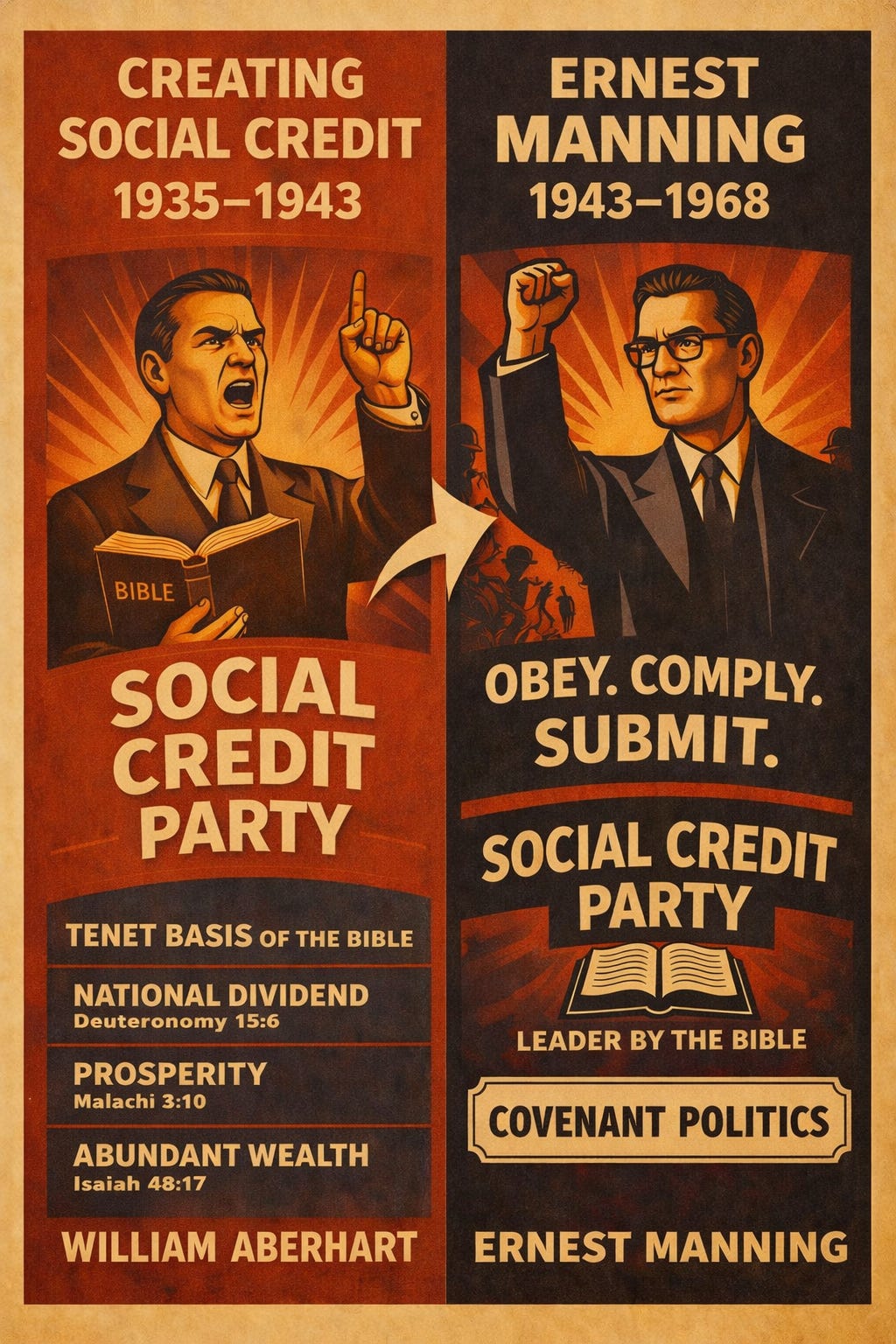
What makes this transformation particularly striking is that it did not require the abandonment of the original tenets. Instead, it relied on their reinterpretation. “Abundant Wealth,” once a justification for redistribution, became evidence of the success of a system that should not be disturbed. “Security,” once tied to economic justice, became associated with vigilance against external and internal threats. “Prosperity,” once collective, became individualized.
This is the essence of the shift: the language remains constant, but its direction is reversed. Where the earlier framework looked inward, asking how society could better serve its members, the later framework looked outward, asking how society could defend itself from perceived dangers. The moral centre moved from obligation to preservation, from inclusion to boundary-setting.
The visual and rhetorical tone followed suit. The warmth of communal imagery gave way to sharper, more disciplined aesthetics. The emphasis on shared humanity was replaced by an emphasis on strength, order, and resolve. The narrative was no longer about correcting imbalance, but about maintaining stability in a world perceived as increasingly hostile.
THE ROLE OF RELIGION: FROM SOCIAL ETHIC TO LEGITIMIZING FORCE
Religion remained a constant presence throughout this evolution, but its function changed significantly. Under Aberhart, biblical references served as a foundation for economic ethics. They were invoked to justify redistribution, care for the poor, and collective responsibility. Faith was the source of the movement’s moral imperative.
Under Manning, religion continued to play a central role, but it shifted toward legitimizing authority and reinforcing social cohesion. Biblical language was still present, but it was less about challenging economic structures and more about affirming a moral order aligned with discipline and hierarchy. The focus moved from what society owed its most vulnerable members to what individuals owed to society in terms of conformity and stability.
This shift reflects a broader pattern seen in many political movements: the transition from reformist to institutionalized phases often involves a reorientation of moral language from critique to justification. What begins as a challenge to existing structures can, over time, become a means of sustaining them.
THE LEGACY OF THE TRANSFORMATION
By the end of Manning’s tenure in 1968, Social Credit had become something fundamentally different from its origins. It was no longer a vehicle for reimagining the relationship between wealth and community, but a governing framework aligned with the broader currents of North American conservatism. Its early flirtation with systemic reform had been replaced by a commitment to stability, order, and market-oriented prosperity.
Yet the traces of its origins remained, embedded in its language and symbolism. This is what gives the transformation its enduring significance. It demonstrates how political movements can evolve not by discarding their foundational ideas, but by redefining them. The same words—prosperity, security, abundance—can serve radically different purposes depending on how they are framed.
CONCLUSION: THE QUIET REVERSAL
The evolution of Social Credit in Alberta is not a story of abrupt ideological betrayal, but of gradual recalibration under pressure. It reflects the influence of historical context—the constraints of governance, the realities of war, and the pervasive anxiety of the Cold War era. It shows how a movement rooted in community empowerment can, over time, become oriented toward preservation and control.
Most importantly, it reveals the power of language in political life. When the words remain the same, the change can be difficult to see. But beneath the surface, the direction of those words can shift entirely. What once pointed toward a more equitable distribution of wealth can come to justify the protection of existing structures. What once emphasized collective responsibility can evolve into a call for vigilance against perceived threats.
That is the quiet reversal at the heart of this transformation: a moral economy turned inward becomes a defensive orthodoxy turned outward, carrying its original vocabulary into a new and very different ideological landscape.
CITATIONABLE SOURCES: -
GENERAL / REFERENCE (FOUNDATIONAL OVERVIEW)
The Canadian Encyclopedia — “Social Credit”
Authoritative national reference outlining origins, ideology, and evolution of Social Credit in Canada, including Aberhart and Manning transitions.
https://www.thecanadianencyclopedia.ca/en/article/social-credit
ACADEMIC THESIS / SCHOLARLY ANALYSIS (CORE IDEOLOGICAL EVOLUTION)
McGill University Thesis — Social Credit and Political Ideology in Alberta
Deep academic analysis of Social Credit’s ideological foundations, including its economic theory, religious framing, and transformation over time.
https://escholarship.mcgill.ca/downloads/sq87bw54f.pdf
McMaster University Thesis — Religion and Politics in Alberta Social Credit
Focuses on the Social Gospel roots, Aberhart’s theology, and the transition toward Manning’s more conservative governance framework.
https://macsphere.mcmaster.ca/bitstream/11375/13785/1/fulltext.pdf
University of Calgary Thesis — Alberta Social Credit Governance Evolution
Detailed institutional and ideological study of the shift from Aberhart’s reformist movement to Manning’s long-term political structure.
https://ucalgary.scholaris.ca/bitstreams/d8091ca7-856f-49b5-aa1b-f1110ae6f134/download
University of Lethbridge Thesis — Cold War Influence on Alberta Politics
Examines how postwar anti-communism and North American ideological pressures reshaped Alberta’s political environment and Social Credit positioning.
https://opus.uleth.ca/bitstreams/4f7668df-602c-4de3-8fae-d03351f93373/download
PEER-REVIEWED / HISTORICAL JOURNAL ANALYSIS
York University — Historical Papers (Canadian Historical Association)
Scholarly paper examining Social Credit’s ideological contradictions, including tensions between populism, religion, and anti-socialist positioning.
https://historicalpapers.journals.yorku.ca/index.php/historicalpapers/article/download/39654/35959/48418
PRIMARY / ARCHIVAL & MOVEMENT-SPECIFIC SOURCES
Aberhart Foundation — “Aberhart and Manning” (Primary Movement Analysis)
Direct source material and historical interpretation from within the Social Credit intellectual tradition, detailing leadership transition and philosophy.
https://www.aberhartfoundation.ca/PDF%20Documents/Premier%20PDF%27s/Aberhart%20and%20Manning.pdf
Library and Archives Canada — Social Credit Historical Record (Thesis/Archival Study)
Comprehensive archival-based academic work on Social Credit ideology, governance, and political evolution in Alberta.
https://webdoc.sub.gwdg.de/ebook/p/2005/library_archives_canada/NQ37027.pdf
Library and Archives Canada (Alternate Direct Access Copy)
Mirror archival access to the same foundational document for redundancy and reliability.
https://www.collectionscanada.gc.ca/obj/s4/f2/dsk2/ftp02/NQ37027.pdf
Interesting essay. So it was the Manning fellas that actually turned Aberhart's tenets from what we today might call Socialism into what we see today as the UCP neofascist party.. The Manning Social Credit were essentially a fascist leaning party that supported racism, eugenics and control of people's lives. Witness the "Blue Laws" regulating activities on Sundays. If memory serves, those laws even extended to commercial truckers on the highways. I suspect that with the discovery of oil, the Social Credit saw where they could get in bed with Big Oil and we still have that connection. It actually seems that regardless of what party we elect in Alberta, the myth of OIL is there. The belief that oil is the savior of Alberta is firmly planted in the Alberta psyche.
thank you for this essay