
THE AISH / ADAP REALITY GAP
HOW ALBERTA’S DISABILITY INCOME SYSTEM FAILS BOTH PEOPLE AND THE PROVINCIAL ECONOMY

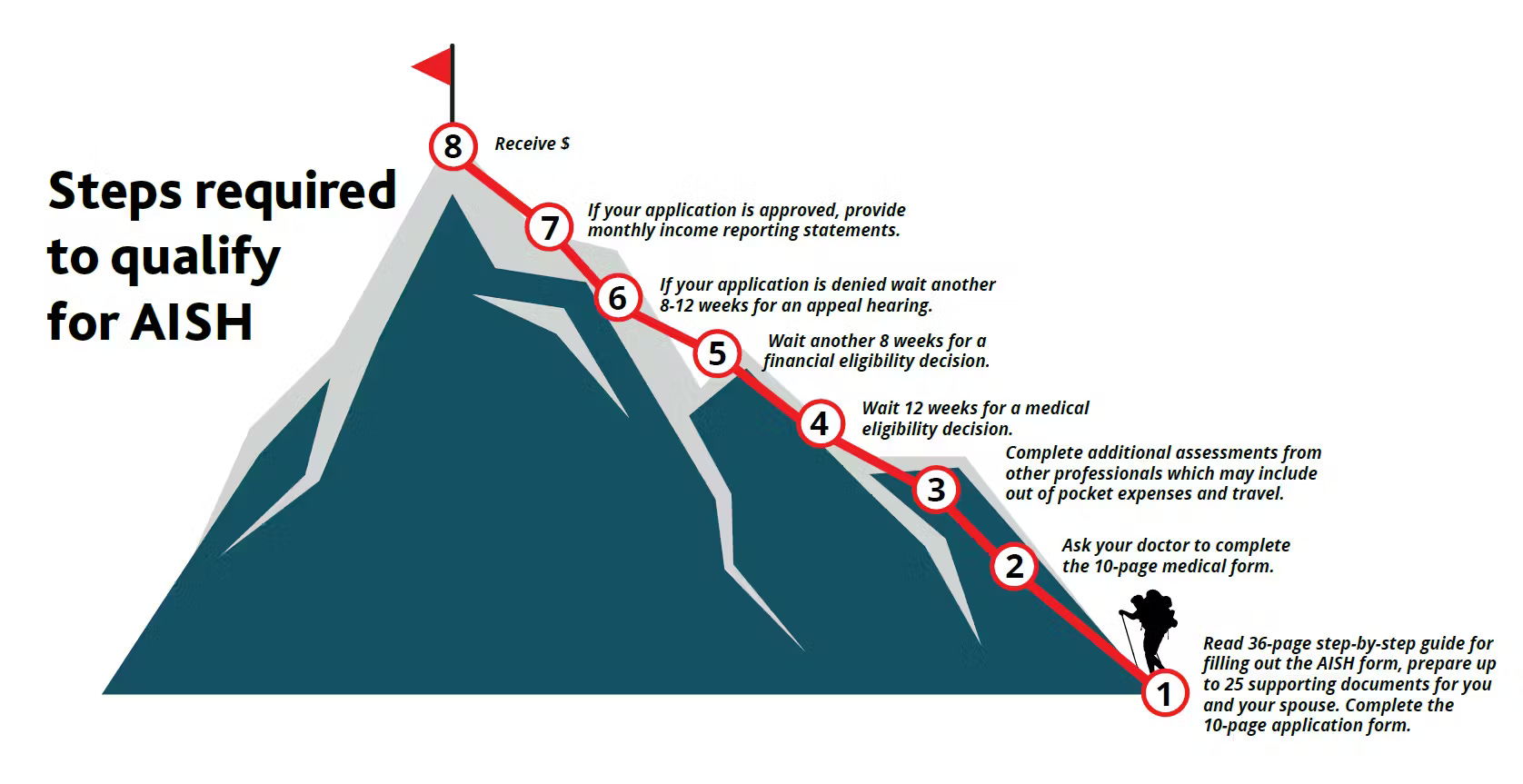
THE TEST OF ANY POLICY IS WHETHER THE NUMBERS MATCH REAL LIFE
There is a straightforward way to evaluate whether a public policy is effective, and it does not require ideology, partisanship, or even debate. It requires math. You take what a system provides, you compare it to what life actually costs, and then you follow what happens when those two numbers do not align. When that test is applied to Alberta’s disability income system, both in its current AISH form and in the proposed transition toward ADAP, the conclusion is not subtle or debatable. The numbers do not match reality, and when that happens, the system built on those numbers begins to fail not just the people it is meant to support, but the broader economic structure that depends on stability at the ground level.
A realistic and workable monthly cost of living for a single adult with a disability in Alberta sits at approximately $3,215 per month, and that number is not built on comfort or excess but on modest and necessary assumptions about rent, food, transportation, communication, basic health costs, and minimal financial resilience. It does not include savings, it does not include meaningful debt repayment, and it does not account for the full range of disability-specific expenses that many individuals face. It is a stability number, not a prosperity number. When that number is placed beside current AISH support levels of approximately $1,940 per month, and the projected ADAP level closer to $1,740 per month, the gap is immediate and structural rather than incidental. The system is not slightly misaligned; it is built on a figure that falls far below the cost of sustaining a basic and stable life.
WHEN THE MATH DOESN’T WORK, THE CONSEQUENCES DON’T DISAPPEAR
It is a common assumption in policy discussions that when funding is reduced or constrained, the system simply “saves money,” but that assumption collapses under scrutiny. When a disability income system is funded below the cost of living, the gap does not vanish into thin air, nor does it quietly resolve itself through individual effort or better budgeting. Instead, it moves, and where it moves is what defines the inefficiency of the system. That gap appears first in the most immediate and visible pressures, such as unpaid rent, rising eviction risk, food insecurity, and inconsistent access to medication, but it does not stop there. It begins to cascade into other systems that are more expensive, less predictable, and far more difficult to manage.
Healthcare systems absorb increased demand as individuals delay care until conditions worsen, turning manageable issues into acute crises. Housing systems face additional strain as instability increases, pushing more people toward shelters or precarious living arrangements. Municipal services, including policing and crisis response, take on responsibilities that originate not from public safety issues, but from economic instability and unmet basic needs. What appears on the provincial ledger as restraint or discipline reappears across the broader system as higher costs, increased complexity, and reduced effectiveness. This is not a reduction in spending; it is a redistribution of cost into areas where it becomes more expensive and less efficient to manage.
THE ECONOMIC REALITY THAT IS CONSISTENTLY IGNORED
There is another dimension to this conversation that is rarely acknowledged in public debate, and it is one that fundamentally alters how these numbers should be understood. Every dollar provided through AISH is spent, and it is spent locally. It goes directly into rent payments within Alberta communities, into groceries purchased from local stores, into pharmacies, utilities, transit systems, and basic services that form the backbone of everyday economic life. It does not accumulate in investment accounts, it does not leave the province, and it does not sit idle waiting to be deployed. It moves immediately and continuously, creating what economists describe as high-velocity spending.
This means that disability income support is not simply a transfer payment from government to individual, but a direct and ongoing injection into the provincial economy. It supports landlords, sustains small businesses, contributes to employment, and reinforces the stability of local markets, particularly in smaller and rural communities where economic diversity is limited and every dollar of consumption carries greater weight. When that support is reduced below livable levels, the impact is not confined to recipients. It reduces spending across entire communities, weakens local economies, and erodes the stability that businesses and services depend on to remain viable.
UNDERFUNDING IS NOT FISCAL DISCIPLINE, IT IS SYSTEMIC INEFFICIENCY
The cost of aligning disability income support with a realistic cost of living, estimated at approximately $3.0 billion annually for roughly 78,000 recipients, is often presented as the central obstacle to reform, with the incremental increase over current levels framed as too large to justify. However, this framing isolates the number from the system it operates within and ignores the cost of maintaining the current gap. Underfunding does not eliminate expenditure; it increases it in less controlled and less efficient forms. It drives administrative complexity as more applications are denied, appealed, and reprocessed, consuming resources that could otherwise be directed toward stability.
It also shifts costs into high-intensity services such as healthcare, emergency housing, and crisis response, where interventions are reactive rather than preventative and significantly more expensive per case. At the same time, it suppresses economic activity that would otherwise circulate through communities, reducing the very tax base and economic resilience that governments rely on. A system that spends less at the point where support is most effective and more at the point where intervention is least efficient cannot reasonably be described as fiscally responsible. It is, by definition, inefficient.
REAL LIFE DOES NOT RESET WHEN DISABILITY OCCURS
One of the most significant disconnects within the current AISH and ADAP framework is the implicit assumption that individuals enter disability without financial history or ongoing obligations. In reality, people carry debt from their lives before their condition changed, including credit obligations, loans, and financial commitments that do not disappear when income does. Many individuals also have families, dependents, or shared responsibilities that continue regardless of their ability to work. At the same time, disability introduces new and unavoidable costs, including transportation challenges, medical expenses not fully covered, mobility supports, and the time burden associated with managing complex health needs.
When a system is calibrated below subsistence, it effectively requires individuals to absorb these realities without adequate support, forcing them into cycles of debt, reliance on informal networks, or eventual crisis. These outcomes are not anomalies; they are predictable consequences of a system that does not account for the full context of people’s lives. The result is not reduced cost, but increased instability that reverberates outward into families, communities, and public systems.
UNCERTAINTY AND ADMINISTRATIVE FRICTION INCREASE COSTS RATHER THAN REDUCING THEM
As Alberta transitions toward ADAP, additional structural concerns emerge that further undermine efficiency. When eligibility definitions become less clear, when appeal mechanisms are constrained or difficult to access, and when benefit levels can be adjusted through regulatory processes rather than transparent legislative debate, uncertainty increases across the system. That uncertainty does not create flexibility in a practical sense; it creates friction.
Friction leads to delays in decision-making, increases the likelihood of initial denials, and drives a higher volume of appeals and reapplications. Each of these steps consumes administrative resources, prolongs instability for individuals, and increases the likelihood that problems will escalate into more costly interventions elsewhere. What is presented as streamlined or adaptable governance often becomes a more complex and expensive system to operate in practice.
THE CORE CONTRADICTION AT THE HEART OF THE SYSTEM
The AISH and ADAP approach is frequently described in terms that suggest control, discipline, and responsible management of public resources, but when examined through the lens of actual outcomes, it reveals a fundamental contradiction. The system underfunds basic needs while increasing demand on more expensive services, reduces local economic circulation while amplifying instability, and introduces administrative complexity that consumes resources without improving outcomes. It shifts costs away from predictable, manageable support and into reactive, high-cost systems that are harder to control and more expensive to sustain.
This is not a marginal inefficiency or a matter of fine-tuning policy. It is a structural misalignment between what is provided and what is required for stability, and that misalignment produces consequences that are both human and economic in nature.
THE QUESTION THAT CAN NO LONGER BE AVOIDED
At its core, this is no longer a question about generosity, ideology, or political positioning. It is a question about whether the system reflects reality. What does it actually cost to live in Alberta with a disability, and what happens when individuals are consistently unable to meet that cost? Once those questions are answered honestly, the framing shifts entirely. The issue is not whether Alberta can afford to align disability support with real living costs. The issue is whether Alberta can afford the inefficiency, instability, and downstream expense of continuing to operate a system that does not.
The ADAP as run and conceived of by the unholy alliance of the unchristian like ucp seems to be calling out for one more letter for their acronym.
I believe that letter is “T” and will stand for “terminated”. The program them becoming known as “ADAPT”
TL;DR:
Libertarians make poor lifeguards.