
WHEN THE FLOOR DISAPPEARS
Power, Disability, and the Collapse of Political Certainty

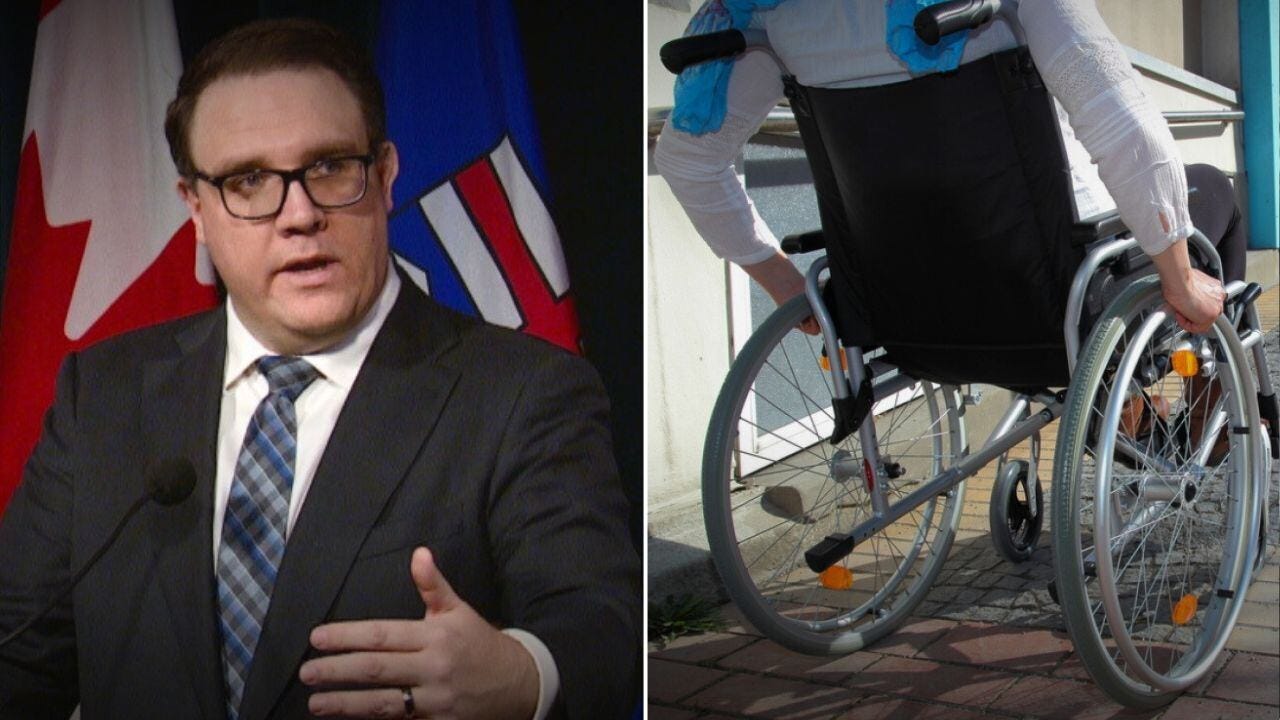
THE DAY IDEOLOGY BECOMES PERSONAL
Imagine being someone like Danielle Smith or Jason Nixon, raised politically inside a worldview built around self-reliance, fiscal restraint, entrepreneurial resilience, and suspicion toward expansive social dependency. You refused lavish pension structures to demonstrate integrity to taxpayers ( Wait. What?). You lived responsibly. You worked constantly. You built a small business you intended to return to after politics. Your mortgage was manageable. Your retirement was still a decade away, but there was a plan. The future looked stable because stability itself appeared to be the reward for discipline.
Then catastrophe enters your life without permission.
Not a scandal. Not an election defeat. Not a temporary financial setback. A physical collapse. A workplace injury. A neurological condition. A severe autoimmune disease. A spinal injury. Chronic pain that does not heal. The body that carried your ambitions suddenly becomes unreliable machinery. You discover that there are forms of suffering that cannot be solved through work ethic, optimism, discipline, or market logic because the very instrument required to exercise those virtues — the human body itself — has broken down.
At first, you tell yourself it is temporary. Most people do. You drain savings believing recovery is around the corner. You refinance debt believing you only need more time. You try to continue working past the point where your body is warning you to stop because your identity is still tied to productivity. But disability has a brutal way of dismantling denial. Slowly the business fails because you physically cannot sustain it. Clients drift away. Bills accumulate. Mortgage payments become terrifying. Relationships strain under the pressure of exhaustion and fear. Your world begins shrinking from public influence to private survival.
Then comes the most psychologically devastating transformation of all: you stop being viewed primarily as a citizen and begin being processed as a liability.

ENTERING THE SYSTEM YOU ONCE GOVERNED
The application process for Assured Income for the Severely Handicapped would feel less like support and more like surrender. Every medical document becomes evidence in a trial where your suffering must be proven repeatedly to strangers. Every form forces you to translate pain into bureaucratic terminology. Your life becomes categorized according to eligibility thresholds, employability criteria, medical verification standards, and administrative timelines.
For someone who once spoke confidently about “government efficiency,” the experience would be disorienting. You would discover that efficiency feels very different when you are the one waiting for approval while rent is due. You would discover that a delayed reassessment letter can produce panic severe enough to destroy sleep. You would discover that policies discussed casually in legislative chambers echo violently inside the lives of people who depend upon them.
Most profoundly, you would encounter the emotional architecture of disability itself.
Disability is not merely physical limitation. It is a social condition imposed by systems built around productivity. The modern economy quietly assumes that human worth is tied to output, speed, flexibility, and endurance. Once your body can no longer meet those demands, society begins renegotiating your value. The disabled learn this quickly. They learn it in suspicious public attitudes. They learn it in humiliating paperwork. They learn it in online comments accusing benefit recipients of laziness or fraud. They learn it in the quiet moral distinction society draws between “taxpayers” and “dependents,” as though human dignity must be earned through economic output.
For a former conservative politician, that realization would be psychologically explosive because it would dismantle one of the deepest assumptions underlying modern neoliberal political culture: the belief that individual control is nearly absolute.
THE COLLAPSE OF THE BOOTSTRAP MYTH
The mythology of total self-reliance survives only at a distance from catastrophe. It functions best when disability remains abstract, statistical, and safely located inside “other people’s lives.” But the moment illness or injury invades your own household, the entire architecture changes. Suddenly phrases like “living within your means” sound grotesquely incomplete because biology itself has destroyed your means. Suddenly “personal responsibility” no longer explains why someone with discipline, savings, work history, and ambition can still end up financially annihilated.
This is where many political worldviews encounter a crisis they are emotionally unprepared for.
Because the truth disability reveals is terrifyingly simple: human beings are breakable. Markets do not prevent neurological disease. Hard work does not stop spinal degeneration. Entrepreneurship does not shield families from catastrophic injury. Prudence cannot always outmaneuver biology. A lifetime of responsible choices can still collapse beneath forces entirely outside personal control.
And once that truth becomes undeniable, the social safety net stops looking like charity.
It starts looking like civilization itself.
The person receiving support is no longer imagined as morally separate from the taxpayer because the distinction can vanish overnight. One diagnosis. One accident. One failed surgery. One autoimmune disorder. One workplace incident. One stroke. One cancer diagnosis. That is all it takes to cross the invisible line between independence and dependency.
The terrifying realization would not merely be that poverty exists. It would be the realization that vulnerability is universal.

THE EMOTIONAL VIOLENCE OF PRECARITY
What most healthy people fail to understand is that poverty under disability conditions operates differently from ordinary financial stress. It is not merely scarcity. It is sustained psychological siege. Every expense becomes existential mathematics. Can groceries still be purchased after medication costs? Can transportation be maintained without missing rent? Can heating bills be paid while waiting for approval delays? The future shrinks into survival intervals measured month by month.
The emotional exhaustion compounds because disability also strips away social identity. Former accomplishments stop mattering. The world becomes oriented around what you can no longer do. A former minister, tradesperson, entrepreneur, nurse, teacher, or business owner can suddenly find themselves reduced administratively to case numbers and functional limitations.
That transformation carries a profound moral injury.
People who once believed themselves to be contributors begin internalizing the language of burden because society subtly encourages them to do so. The disabled are constantly pressured to justify their existence economically. They absorb the message that their legitimacy depends on proving they are suffering “enough” to deserve assistance.
A politician living through that process firsthand would likely begin seeing entire policy debates differently. Budget reductions would no longer appear as abstract governance decisions. They would appear as direct intrusions into the fragile survival systems of real families. Public rhetoric about cracking down on abuse would feel dangerous because it inevitably intensifies suspicion toward everyone receiving help, including the legitimately disabled.
The system would stop being theoretical.
It would become intimate.
THE LESSON SOCIETY REFUSES TO LEARN
The deepest tragedy is that societies often wait until suffering becomes personal before recognizing the humanity of those already enduring it. Political systems built heavily around productivity tend to underestimate how quickly fortune can reverse. Able-bodied populations unconsciously assume permanence in their health because imagining vulnerability is psychologically frightening. It is easier to believe that poverty and dependency happen mainly to the irresponsible than to confront the terrifying randomness of illness and injury.
But disability demolishes that illusion.
It exposes how thin the membrane truly is between security and collapse. It reveals that most people are not separated from desperation by character, but by circumstance. It shows that social support systems are not luxuries for failed citizens but survival infrastructure for fragile human beings living inside unpredictable biological realities.
And perhaps that would be the final revelation for a politician forced into such circumstances. The people they once debated statistically were never abstractions at all.
They were simply earlier versions of themselves.
The “bootstrap” people, first don’t get it that nobody has ever been able to pull themselves “up by the bootstraps.” Nobody has gotten anywhere entirely on their own - support of one kind or another has ALWAYS figured prominently in any success. The other piece is that even if that was possible, you hafta remember, that it’s REALLY impossible if you don’t have boots to start with.
Thank you for this Jon. You put the stark truth out there. Life is so fragile - but until the “politicians” are disabled.. they will never understand. Even then - their career of padding their bank accounts will surely soften the financial burden. We are all just one incident away from a disability.